
Grief hung heavily over Angwan Rukuba in Jos, Plateau State, following the horrific Palm Sunday night attack that claimed the lives of more than 40 Christians and left many others injured. The assault, which occurred on March 29, 2026, has once again plunged the state into mourning, with families shattered and an entire community struggling to come to terms with the scale of the tragedy.
But beyond the bloodshed and sorrow, a new layer of outrage has emerged, one that speaks not only to the violence itself, but to the response of leadership in its aftermath.
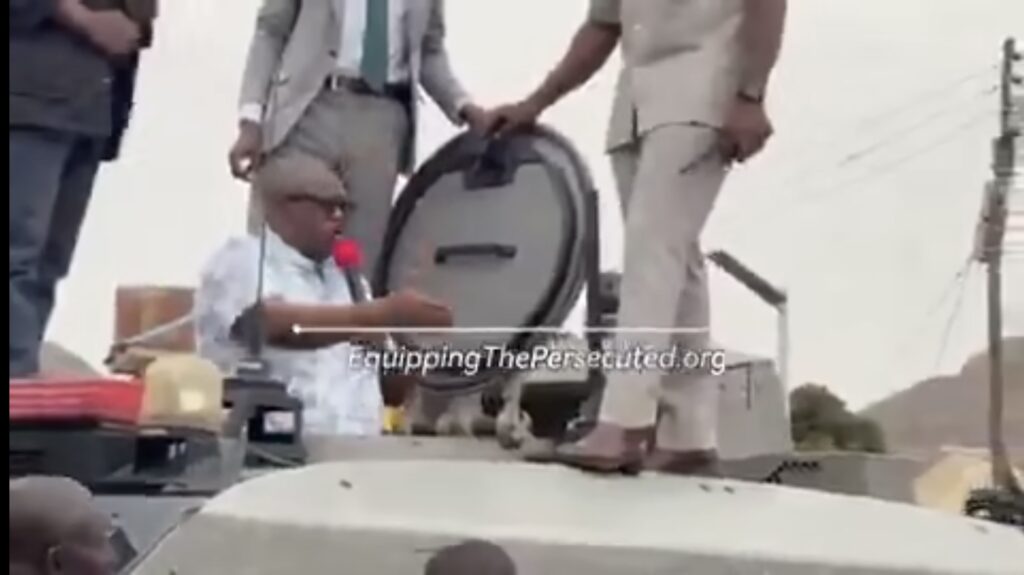
As residents gathered in anguish, seeking comfort, reassurance, and a sense of protection, the image that greeted them was that of the Plateau State Governor, Caleb Mutfwang, addressing them from the confines of an armoured vehicle. For many, it was a moment that deepened pain rather than soothed it, a stark visual contrast between a shielded authority and an exposed, grieving populace.
To a people who had just witnessed and endured terror in their homes, the symbolism was difficult to ignore. While security concerns for public officials are understandable, the decision to remain physically distant at such a sensitive moment has been widely interpreted as a failure of emotional leadership.
In times of crisis, presence is not merely physical, it is symbolic. It reassures, it consoles, and it reflects shared vulnerability. What the people of Angwan Rukuba witnessed instead felt, to many, like separation.
Eyewitnesses recount a night of chaos, sporadic gunfire, desperate attempts to flee, and the haunting silence that followed. Survivors now carry not only the scars of violence but also the burden of unanswered questions. How did such an attack occur? Could it have been prevented? And most critically, will anything change?
The governor’s appearance, rather than uniting the community in shared resolve, has sparked a broader conversation about leadership, empathy, and responsibility. Citizens are increasingly demanding more than statements and symbolic visits; they seek proactive measures, accountability, and visible commitment to safeguarding lives.
This tragedy is not an isolated incident, but part of a troubling pattern that continues to test the resilience of communities across Plateau State. Yet, resilience should not be mistaken for acceptance. The people are not asking for miracles, they are asking for protection, dignity, and leaders who stand with them, not apart from them.
As the nation reflects on the events of that dark Palm Sunday, the memory of lives lost must serve as more than a statistic. It must be a call to action, one that demands both security and humanity in leadership. For in moments of collective pain, the true measure of leadership is not found behind armour, but in the courage to stand visibly and vulnerably with the people.
Photo Credit: Equippingthepersecuted.org
