
For years, the ASUSS House was a painful eyesore, an abandoned project that stood as a public embarrassment to the Academic Staff Union of Secondary Schools (ASUSS), Ondo State chapter.
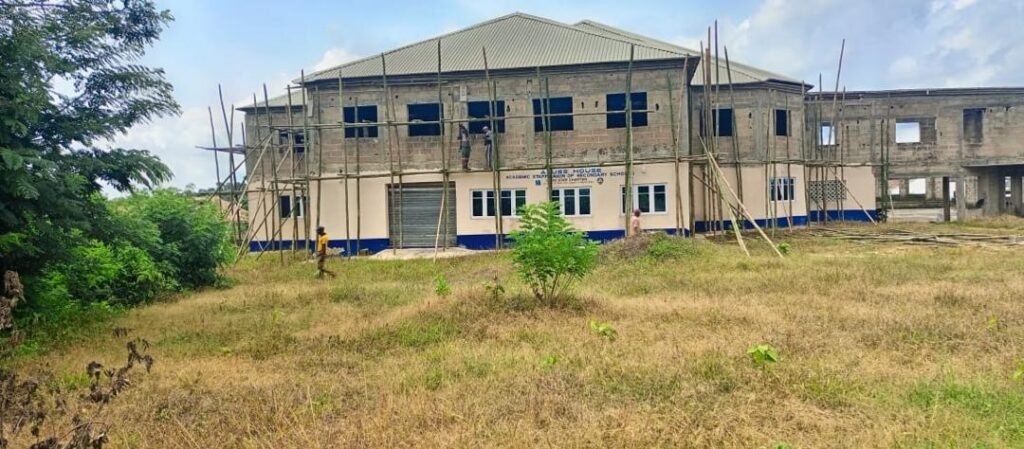
Left in a devastated and barren state, the structure became a harsh reminder of wasted opportunities, broken trust and a leadership era many members have continued to describe as lacking in vision, purpose and accountability.
To many teachers, the abandoned building represented far more than uncompleted blocks and empty spaces. It was seen as a symbol of stagnation, secrecy and misplaced priorities , a project that should have reflected the strength and unity of the union, but instead exposed the failure of those who once held its reins.
For years, members watched helplessly as the dream of a befitting ASUSS House faded into near hopelessness.
That narrative, however, is changing under the leadership of Comrade Amuda Tairu Abiola.
In what many members have described as one of the clearest signs of purposeful leadership in recent times, the current chairman has revived the long-neglected ASUSS House project, turning what was once a monument of disappointment into a fresh symbol of hope and progress.
The visible work ongoing at the site has not only revived the building, but also rekindled confidence among members who had grown weary of endless promises and little action.
The transformation of the project has drawn commendation from many within the union, who say the current administration has demonstrated a level of commitment that sharply contrasts with the years when the project was left to decay.
To them, the renewed progress on the ASUSS House is proof that the difference between failure and success often lies in the quality of leadership.
Critics of the past administrations have not hidden their feelings, insisting that the abandoned state of the project was a reflection of an era plagued by “padi-padi” politics, secrecy and a troubling disconnect from the needs of ordinary members.
They argue that resources meant to advance the welfare of teachers were left in the hands of a system that lacked both transparency and the will to deliver tangible results.
But under Comrade Amuda, supporters say a new culture is beginning to take shape — one rooted in action, openness and a genuine determination to work for the collective interest of members.
In a short time, they argue, the chairman has shown that leadership is not about empty slogans or selfish calculations, but about confronting problems directly and producing visible results that inspire confidence.
For many members, the revival of the ASUSS House is therefore more than a construction achievement; it is a restoration of trust in union leadership. It is a sign that ASUSS can rise above the failures of the past and move toward a future defined by responsibility, service and meaningful progress.
As the building gradually takes shape, members have been urged to rally behind the current administration and support every effort aimed at strengthening the union. For them, the rebirth of the ASUSS House is not just the completion of a project, it is the beginning of a new chapter, one in which ASUSS can once again stand tall as a union driven by purpose, unity and results.
From the ruins of abandonment, a new symbol is emerging. And in the eyes of many teachers, that symbol bears the unmistakable imprint of Comrade Amuda Tairu Abiola’s leadership.
