
In Nigeria today, darkness is no longer just the absence of electricity, it is fast becoming a symbol of broken expectations.
From crowded urban neighborhoods to quiet rural towns, the complaint is the same: the lights are still not on, and patience is wearing thin.
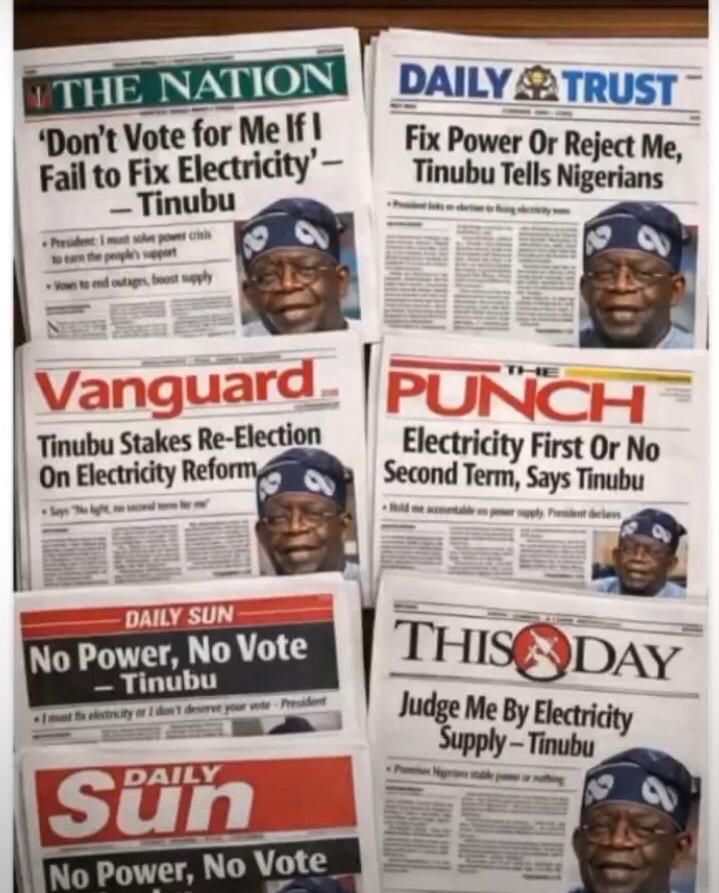
But beyond the usual frustration lies something more potent, a reminder. Nigerians are reaching back to the campaign trail, pulling forward a bold declaration made by President Bola Ahmed Tinubu himself.
In seeking the nation’s highest office, he gave a clear condition: if he could not fix electricity within four years, he should not be trusted with another term.
Now, that promise has returned, this time, not as inspiration, but as accountability.
Across the country, citizens are quoting his words with increasing urgency. In bus parks, in offices, on radio shows, and across social conversations, the refrain is unmistakable: “You said we shouldn’t vote for you again if there is no power.” It is a rare moment where political rhetoric has transformed into a measuring stick in real time.
The hardship fueling this reminder is undeniable. Businesses are suffocating under the cost of diesel and petrol. Artisans are losing income. Students are forced to read in dim light, or not at all.
Even basic comfort has become a luxury in a nation so rich in human and natural resources.
Electricity, long described as the backbone of development, remains one of Nigeria’s weakest links.
And while the structural problems of the sector are well known aging infrastructure, inadequate generation, and persistent inefficiencies, Nigerians are less interested in explanations and more focused on results.
This is the burden of leadership: promises are not made in a vacuum. They carry weight, and over time, they demand to be answered.
What makes this moment compelling is not just the criticism, but the clarity of expectation. The timeline was set by the President himself.
Four years. Stable electricity. A simple but powerful benchmark.
There is still a window for change. Policies can be accelerated, reforms can be deepened, and results can still emerge.
But as each day passes without meaningful improvement, the words spoken during the campaign grow louder in the public consciousness.
In the end, this is not merely about electricity. It is about trust. And in a nation where trust in leadership has often been fragile, keeping one’s word may prove to be the most powerful source of light.
Until then, Nigerians are waiting, watching, enduring, and reminding.
