
I was out on a quiet walk when I saw it, something so small, yet so arresting that it held me still.
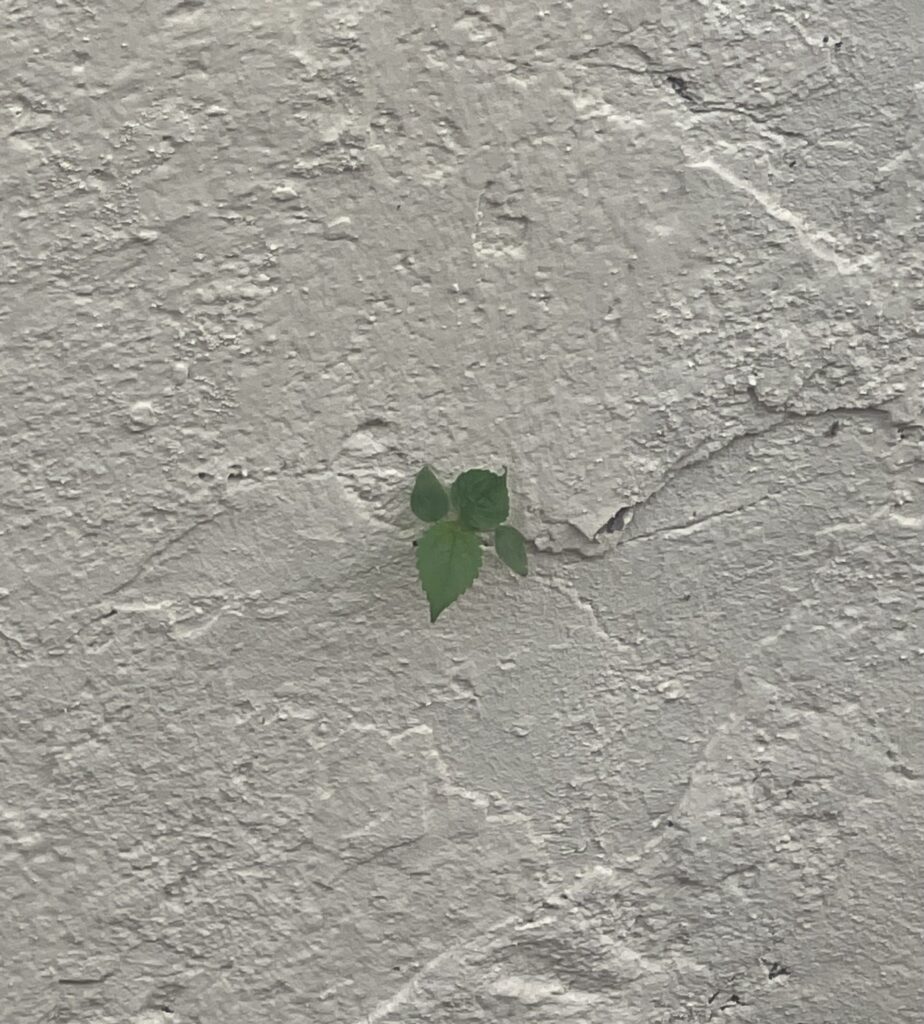
A tender green plant, pushing its way through a freshly painted concrete wall.
At first glance, it felt like a contradiction. Fresh paint speaks of renewal, of order, of something maintained and controlled. But right there, cutting through that polished surface, was life, uninvited, unplanned, and unstoppable.
In that moment, I found myself reflecting deeply on how blessed we are, in Nigeria.
What I witnessed was not just a random occurrence. It was nature, doing what it has always done, finding a way to continue to unveil the mystery behind our existence.
Somewhere, somehow, a seed found its way into a crack in that wall. Perhaps it was carried by the wind, washed in by rain, or dropped there unnoticed. That tiny opening, invisible to most, became a world of possibility.
Dust gathered. Moisture settled. Conditions aligned. And the seed responded.
It did not wait for a perfect soil.
It did not complain about the hardness of its surroundings.
It simply began to grow.
Quietly, persistently, it pushed its roots into the smallest spaces, drawing life from what little was available. It stretched itself toward light, breaking through resistance that, to the human eye, appears unbreakable. Over time, that which seemed solid, yielding, if only slightly and growing into a steady insistence of life and existence, then there’s something to decipher.
And there it stood: a fragile plant, defying concrete, at that moment, I saw more than a scientific explanation. I saw a mirror, with a mystery.
Nigeria is blessed, richly blessed in people, culture, intellect, and natural endowment. Everywhere you look, there is an evidence of a potential waiting to be expressed and explored. Yet, like that plant, so much of our growth happens in spite of the structures around us, not because of them.
We have become a people who thrive in cracks, despite the failure of the managers of our land.
We innovate in tight corners.
We survive under pressure.
We rise, again and again, from conditions that should ordinarily suppress us.
And while that resilience is admirable, it also raises an uncomfortable truth.
A plant that grows through concrete survives, but it may not flourish, as it would in fertile soil. It expends more energy, faces more resistance, and achieves less than its full potential, not because it lacks life, but because its environment limits it.
That is the paradox we live with.
We celebrate our strength, our hustle, our ability to “make a way.” And rightly so, but we must also ask ourselves: what if we did not have to struggle so hard just to grow?
What if our systems, our leadership, and our collective choices created conditions where growth was natural, not forced?
The issue is and remains the management, of who and what we have, as a people.
We have a nation where life insists on emerging, even through the hardest surfaces. Where talent, ideas, and enterprise find expression against all odds, but imagine, just for a moment, what would happen if that same energy met support instead of resistance, if the cracks were replaced with fertile ground, if an average home could fend for themselves and the less privileged could access social amenities with ease and across board, make life a better place for all and sundry, irrespective of their status.
That small plant on the wall carries two powerful messages.
First, it is a reminder of hope: that life will always find a way, no matter how constrained the environment may be.
But secondly, it is a call to responsibility: that the quality of the environment determines how far, life can go.
Yes, God is able. That much is clear.
But perhaps the deeper question is this, if something so small can defy concrete, what could a nation become, if it stopped standing in the way of its own growth?
In that moment again, I saw more than biology. I saw a mirror, loud in mystery.
The issue is not a lack of blessing, as the evidence is all around us.
The issue, is poor management.
Emmanuel Oriowo.
